nature · FOLLOW YOUR CURIOSITY
How migrating birds keep course when landmarks vanish
When coasts, mountains, and familiar routes disappear, migrating birds do not rely on a single backup. Research points to a flexible toolkit of compass and map-like cues that changes by species and situation.
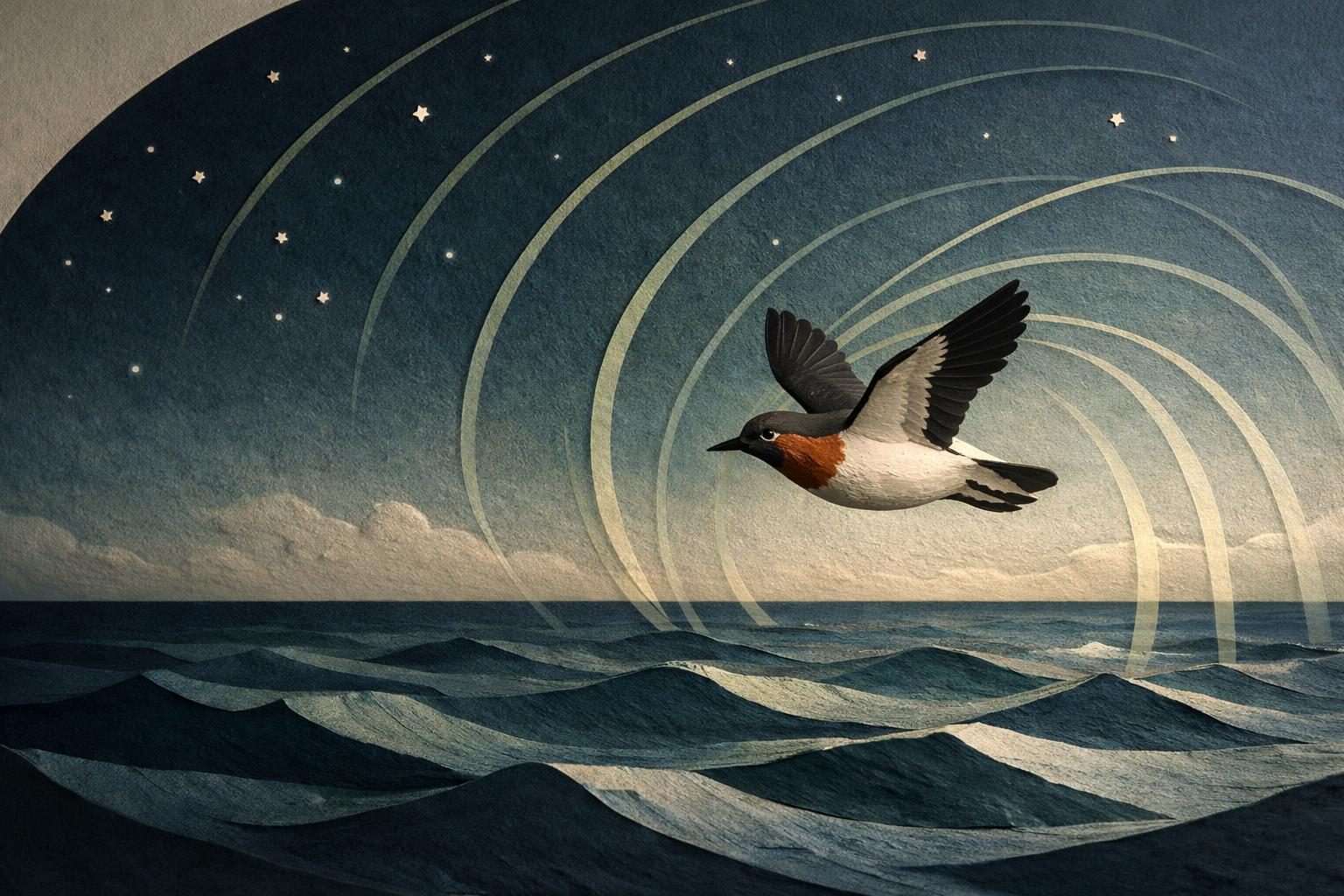
Explore the interactive discovery →
Which cue fits best when the landscape is no help?
Pick the case that best matches the evidence. Different species solved the 'no landmarks' problem in different ways, so this is a comparison of documented situations rather than a universal rule.
Reed warbler in a virtual magnetic displacement experiment
This case supports a magnetic map-like cue. In reed warblers, successful re-orientation in the experiment depended on trigeminal input, suggesting positional magnetic information mattered.
Mediterranean shearwater over pelagic water
This case points most strongly to smell, with topography as help when available. In that study, olfactory deprivation impaired navigation, while magnetic disturbance did not produce the same effect.
Lesser black-backed gull after displacement
This case also supports an olfactory contribution. Gulls with intact olfactory nerves compensated better than birds whose olfactory nerves were cut.
These results come from different species and experimental designs. They show that cue use is context-dependent, not that one cue always replaces landmarks.
Birds use both a compass and a map
A useful distinction is direction versus position. A compass tells a bird which way to go; a map helps it estimate where it is. Reviews of migration research argue that long-distance navigation cannot be reduced to landmarks alone. Birds may combine celestial cues, magnetic direction, smell, topography, and experience, switching emphasis when one source becomes unreliable or unavailable.
Is the magnetic sense just one single system?
See what happens
No. The evidence separates magnetic compass and magnetic map functions.
A magnetic compass helps with direction, and in European robins it appears to be vision-mediated rather than dependent on trigeminal input. By contrast, the reed warbler study found trigeminal input was necessary for magnetic map navigation. That means birds may process magnetic direction and magnetic position through different sensory pathways.
What happens after birds are displaced?
- Common cuckoos
- showed compensatory movements toward population-specific staging areas, supporting true navigation beyond simple landmark-following or fixed-vector travel
- White-throated sparrows
- did not show clear goal-ward compensation after cross-continental displacement; a constant-vector strategy was proposed as one interpretation rather than confirmed as the sole mechanism
- General lesson
- experienced migrants are not all equivalent: some appear able to correct position, while others may not compensate in the same way under displacement
Displacement studies are a key test because they ask whether a bird can adjust from an unexpected place. The answer varies by species, which is why researchers favor a flexible, multisensory model rather than a single navigation rule.
AN IDEA TO TAKE WITH YOU
When landmarks disappear, many migratory birds still navigate by combining cues such as magnetic direction, positional magnetic information, smell, celestial signals, and experience—but not every species uses the same mix.
Follow a connection
The Moon is not changing shape. You are changing the view. →
Another navigation story built around changing viewpoint and orientation cues.
Sources and transparency
www.annualreviews.org · The Neural Basis of Long-Distance Navigation in Birds | Annual Reviews
Accessed: 2026-10-28T21:28:04.966Z
www.nature.com · Flexible navigation response in common cuckoos Cuculus canorus displaced experimentally during migration | Scientific Reports
Accessed: 2026-10-28T21:28:04.966Z
www.nature.com · Long-distance navigation and magnetoreception in migratory animals | Nature
Accessed: 2026-10-28T21:28:04.966Z
www.nature.com · Magnetic map navigation in a migratory songbird requires trigeminal input | Scientific Reports
Accessed: 2026-10-28T21:28:04.966Z
www.nature.com · Olfaction and topography, but not magnetic cues, control navigation in a pelagic seabird: displacements with shearwaters in the Mediterranean Sea | Scientific Reports
Accessed: 2026-10-28T21:28:04.966Z
www.nature.com · True navigation in migrating gulls requires intact olfactory nerves | Scientific Reports
Accessed: 2026-10-28T21:28:04.966Z
www.nature.com · Experienced migratory songbirds do not display goal-ward orientation after release following a cross-continental displacement: an automated telemetry study | Scientific Reports
Accessed: 2026-10-28T21:28:04.966Z
www.nature.com · Visual but not trigeminal mediation of magnetic compass information in a migratory bird | Nature
Accessed: 2026-10-28T21:28:04.966Z
Prepared with AI assistance. Illustrations are explanatory, not evidence. You can report an issue in the interactive discovery.